Project Portfolio Management for R&D and Product Development
Project Portfolio Management (PPM) is important for R&D teams and product development organizations to find and prioritize projects that create the most value with available resources. It is a discipline for handling project evaluation, resource allocation, and project risks in a continuous flow of projects throughout their lifecycle. Learn about the key aspects of PPM to develop your own process.
Project Portfolio Management: What is it and why does it matter
Project Portfolio Management (PPM) is the discipline of choosing, prioritizing, and steering projects so that your organization invests its time and resources in the work that creates the most value and supports the overall strategy. Instead of looking at each project in isolation, PPM takes a broader view: the full set of ongoing and proposed projects, their expected benefits, their risks, and their demands on shared resources.
For R&D and product development, this perspective is essential. Ideas are plentiful, but engineering time, specialist competence, and budgets are not. Without a structured way to compare opportunities, balance workloads, and manage uncertainty and risk, it’s easy to commit to too many initiatives or focus on the wrong ones. The result can be delays, wasted effort, and teams stretched too thin.
Effective portfolio management helps you choose the right projects and make the best use of limited resources.
Selecting the right project
Estimating the benefits
We do projects to achieve a benefit. Often it is monetary, to generate revenue. In other cases, the benefit is less directly monetary, such as adapting to new regulations so that we can continue to generate revenue in the future. In any case, we measure the benefit against the baseline of not doing the project.
It is important to consider the uncertainty in the size of the benefit and the time frame in which we will receive it. In the case of a new product, we expect a profit margin for each unit, a number of units sold each month, and a drop-off in sales when the product becomes obsolete sometime in the future. Put numbers on the uncertainties. That way you will not forget that they exist, and you can discuss them and revise them as you learn more.
There may be ongoing costs after the project is completed, reducing the benefit, such as sales costs, support, and product-sustaining costs. Remember that a project can have side effects. Our new product may replace an older one, reducing its sales and lowering the overall benefit.
The benefits can be time-sensitive. If we release our new product before the competitor, we may increase market share. Failing to meet a hard deadline could cause a sales stop, fines, or liquidated damages. The timing of costs and revenues, together with the discount rate you use, affects the financial analysis of the project.
Estimating costs and time
Executing a project costs money both for the work required and for the materials and services needed. Project managers and teams are used to estimating the time required to complete a project. That does not mean it is easy or that the estimates will be accurate. The team should include uncertainty in their estimates, for many reasons. One reason is that it clarifies what the estimate actually means, and makes it easier to discuss and revise. Another is that it highlights where the uncertainty resides.
Besides the general uncertainty about how much work the project requires, there are often more concrete project risks to consider. For example, for products containing electronics, there is almost always a considerable risk that they will not pass certification tests on the first attempt. These risks should also be quantified to see what the effect could be on both total cost and timeline.
Estimating when a project can be completed is more difficult than estimating the cost, but it is important for the cost-benefit analysis. Risks and uncertainties accumulate across projects that share resources, and their combined effect is almost impossible to calculate without proper support from a project-management tool. Not taking risk and uncertainty into account may however skew the results of your analysis.
When done, you should have an estimate with uncertainty both for the cost of work and external costs, and for when the project can be completed. You should be able to assess if there are areas that would benefit from additional investigation to reduce uncertainty.
Prioritizing projects
You probably have more good project proposals than you have capacity for, so project prioritization becomes essential to decide which one to do first. When you have estimates for both costs and benefits, it sounds straightforward to select the best. However, the definition of best may vary:
There may be reasons you prefer small profits soon over big profits long term. You may be more or less willing to take risks. You may want to avoid big upfront costs, or maybe you have a budget you want to spend.
Another consideration is what resources you have available and how they match each project’s needs. When starting a new project, you not only compare it with other prospects, you also need to prioritize it against already ongoing projects. Resource allocation is a core part of project portfolio management. To find the allocation that produces the most benefits and lowest risk in a balance of your choosing, you need a management tool that supports scenario planning so you can investigate the effect of different alternatives.
Flawless execution of the wrong project will still lead you to, let’s call it, less than optimal results.
Managing the project pipeline
Your project goes through a number of phases in its life-cycle. From idea to ready plan, execution and finally closed. Regardless of whether you have formalized and named a specific set of phases or not, they do exist in some form. We use the project pipeline as a metaphor: it feeds well-prepared projects into the “engine” - the team that will execute them. Managing the pipeline is about making sure there are always well-prepared projects for the engine to chew on, and about governing the flow so that it can run optimally.
Managing project concurrency and team allocation
You want each project to spend as little time in the execution phase as possible. Whether your motivation comes from Lean principles, investment logic, or simply the desire to satisfy customers, once you commit to a project you want it finished. However, no number of cooks will roast a turkey in five minutes. There is a limit for every project where adding more people adds more cost and overhead than the resulting speed-up is worth.
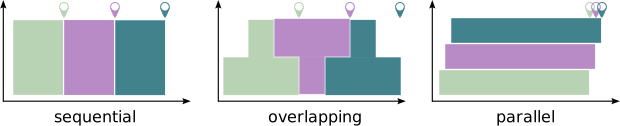
As with the grilled turkey analogy, there may be situations in the project where you just have to wait for processes or external services you can’t hurry. Straining this analogy to its limits, your team is not all cooks. You have specialists, the equivalent of butchers and dishwashers, who contribute at different stages of a project. That’s another reason why you need to have more than one project active at the same time for your team to work efficiently.
Some departments still prefer to organize their staff into fixed-size teams, each working on separate projects. This makes planning easier by avoiding the complexity of shared resources. With an adequate project planning tool, however, handling shared resources is not a problem.
The practical advice: Have one project as the highest priority, and give it the resources it can efficiently use at any given time. Start a second project when there are resources available that the highest-priority project cannot use. For a big department, maybe even a third. Let each project have a small core team that continues to work even when it has low priority. Restarting a project that has been abandoned for a while can be difficult and introduce waste, and the core team can onboard new resources when they become available.
Have background projects or tasks ready for when people are temporarily blocked from working on high-priority projects. These can be smaller, time-insensitive efforts or feasibility studies for upcoming projects. Having a co-worker come to work without something meaningful to do is not only wasteful, but also devastating for morale.
Balancing time to market, cost and risk
When making decisions for projects we often have to make a trade-off between focusing on time to market, keeping costs down, or reducing risks.
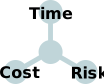
The time and cost balance is often easy to see, for example when paying extra for express service. Adding more people may cut time to market, but the onboarding and extra overhead increase the total cost.
The risk aspect can come in different varieties. You can choose to take risks to possibly save time or money, or go slow to avoid risk. For example, do you build test fixtures based on prototypes that have not been verified, risking that much of the work must be redone, or do you wait until the design is finalized?
Another type of risk has to do with staffing. Do you base crucial parts of the project on one key person, or add people to build some redundancy? Do you entrust important work to an inexperienced team member who can start immediately, or do you wait for the expert to become available?
There is no universal guide to the right choice. People tend to be careful about direct spending, even when it is insignificant compared to labor costs and delays. Extra work, on the other hand, is often undervalued, not only for its cost but also for the opportunity cost of what could have been done instead.
Feeding the pipeline
So far we have assumed that there are plenty of good ideas for projects and products. You probably have, but to make sure you capture the best ideas, you need routines to collect them from all their sources. Customer-facing parts of the organization, like sales and support, can catch what customers say they want and what problems they actually have. Production and procurement may highlight cost-saving or quality-boosting changes. From the R&D team you can expect insight into what is or will be technically possible, and ideas for features that solve customer problems.
Do not only collect ideas for solutions. It is equally important to discover where there are problems worth solving.
There is also a need for a business-intelligence function to actively explore business trends, what competitors are doing, and what is happening with regulations and markets.
All this needs to be managed, filtered, and sorted to create both project proposals and a strategy. Proposals need further work before some of them can be turned into a ready-to-start project plan. And that plan needs to be ready when resources become available.
Without a process, it may be the salesperson who most loudly proclaims “This is what the customers want!” who ends up deciding what the next project will be.
Follow up, change management, and governance
Monitoring and reacting to change
You will never again know as little about the project as you do on the day you start it. Not being ready to adjust when new insights are discovered is what makes a process waterfall-like and problematic. This applies not only to scheduling and staffing, but also specifications and goals.
Example: You set out to develop a product that measures room temperature. You specify the accuracy as ±0.1 °C, because it seems reasonable and is a nice round number. During development you discover that ±0.1 °C is difficult to achieve when the product ambient temperature range is -20 °C to +50 °C. You can reach ±0.3 °C with a normal design, but ±0.1 °C would require expensive precision components and calibration, increasing product cost. Is the specification as written truly required for the product to be useful, and will customers accept the extra cost?
Late changes to specifications and goals can be very expensive. This is an incentive to spend enough effort to get it right before the project starts, not to avoid necessary changes later. When a change is needed, make sure you understand the consequences and that it is worth the extra cost and delay it may cause.
Discovering problems early
It is important to discover problems and risks as early as possible. This gives you more options to do something about them, regardless if it affects budget, timeline or other goals. Human nature and organizational culture can make early discovery more difficult. It may be convenient to underestimate a risk as long as there is a possibility that it will turn out fine, and it is easy to ignore the signs and signals when dealing with them is unpleasant.
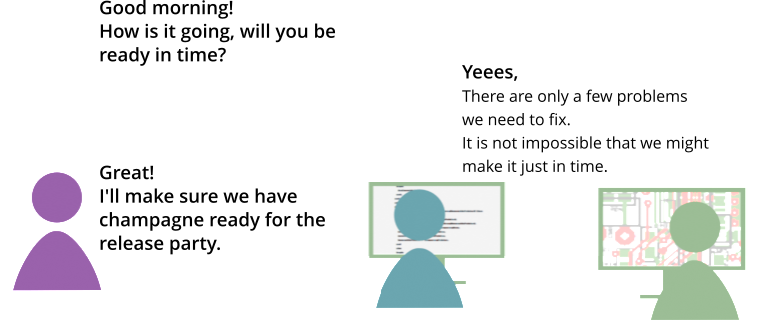
Using a tool that gives you more fact-based status information makes it a conscious decision to ignore warning signals, and makes it possible to get early warnings. For projects with shared resources it can be very difficult for a human to discover how interactions between projects create problems.
Stopping or pausing projects
New information discovered after a project has started may change the cost-benefit analysis enough that the best course of action is to abort it. This is usually a difficult decision, as it is often seen as a failure. It may also be affected by the sunken cost fallacy in two ways: directly, because it is hard to abandon something you have already spent a lot of resources on, and indirectly, by comparing the total cost of the project with the expected benefits. You cannot do anything about the effort already spent. What you need to compare is whether the additional effort required to achieve the benefits is worth it, or if those resources would be better spent on a different project.
If there are known risks, organize the project so that they are evaluated as early as possible, and plan checkpoints in advance to make go/no-go decisions.
Pausing a project may be necessary to free resources for goals with higher priority. The important thing about pausing is to do it in a controlled way, giving the project time to prepare for a restart. Stopping and starting a project will always take extra effort, and restarting one that was suddenly abandoned will lead to even more waste.
Optimizing and discovering opportunities
Assigning team members to project work is the main way to influence project progress. To do this well you need to understand task interdependence and be able to predict availability and actively work to find the best allocation of your team.
Long-term prediction of availability guides your decision of what project to start next, and when to do so.
A strict prioritization of projects with shared resources may hide opportunities. Sometimes lending a key competence to a lower priority project for a very short while can unlock progress, without meaningfully affecting the prioritized project.
How The PlanMinder can help
The PlanMinder is a project planning tool with its roots in product development teams. It is designed to save time on administrative work and give you better plans, even when estimates are uncertain, resources are shared, and priorities often change. It enables continuous project planning through automatic scheduling, automatic feedback from time reports, and by handling uncertainty. This also makes it a powerful tool for project portfolio management.
Budget estimates and uncertainty
When you estimate work in The PlanMinder, you provide two numbers: one for the best-case scenario, and one you’re reasonably confident will be enough, considering all that might go wrong. The tool aggregates the uncertainty from all individual activities and produces a probability distribution for the total amount of work required to finish the project.
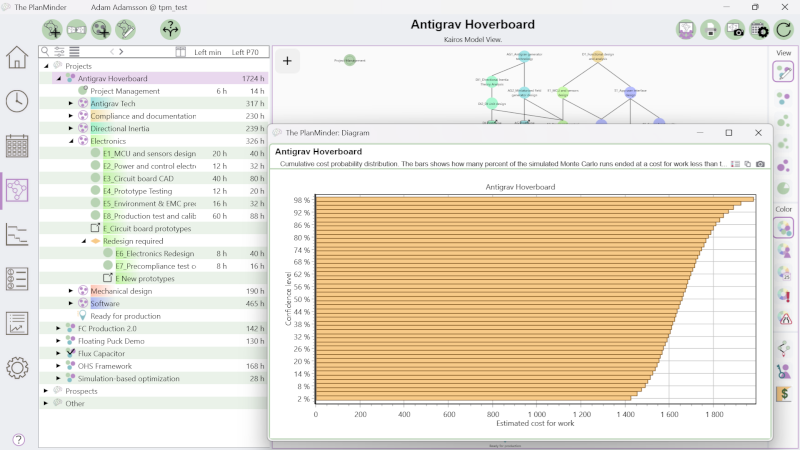
You can also model discrete risks in the project, such as not passing certification tests, and see how it contributes to the total uncertainty.
Timeline uncertainty and availability
The automatic scheduler in The PlanMinder runs Monte Carlo simulations to calculate the uncertainty of when milestones will be reached and projects completed. These results can be displayed as box-and-whisker plots or as a full distribution.

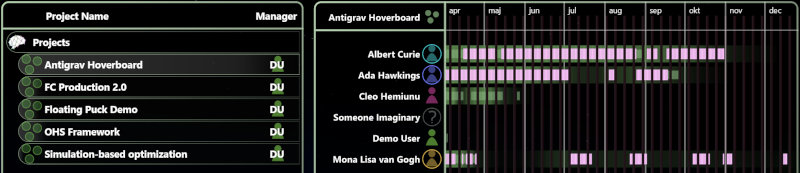
The availability plot shows when team members are scheduled and when they are likely to be available for new assignments. It also shows how the selected project is scheduled across the team.
Monitoring and early warnings
The feedback from time reports keeps plans up to date with what is actually happening in the project. As team members report time in the tool, refining estimates also becomes a natural part of the workflow. This makes it easy to monitor the progress of a project.

For deadlines, The PlanMinder calculates how likely it is that they will be reached on time. If that probability drops as work progresses, you have an early warning and can use the scenario mode to find effective mitigations. The PlanMinder accumulates uncertainty across all scheduled projects and flags problems caused by complex project interactions that would otherwise be difficult to predict.
Immediate feedback and Scenario Mode
The automatic scheduler makes it easy to adjust plans and resource allocation, and lets you immediately see the effect of those changes. Changing project priority is a simple drag-and-drop operation that directly updates the milestone and availability plots.

To test the effect of changes before making decisions, you can use the scenario mode. In a scenario, you can also set a discrete risk to 100% to explore what happens if it fails, and prepare a plan B in advance.
Communicating status and effects
Visualizations of project plans and status, together with the tool for project reports, make it easy to communicate both current status and the effects of changes.

Advanced analysis tools
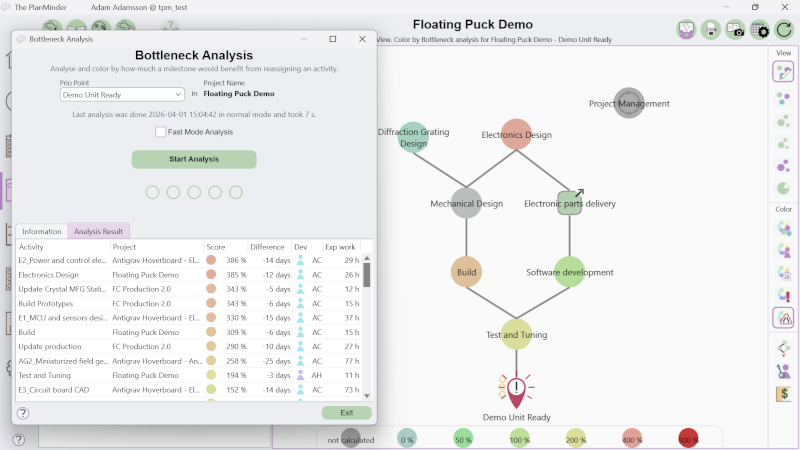
The PlanMinder includes effective tools to help you optimize plans and find the best way to assign resources. It also offers advanced analysis features that identify critical activities, bottlenecks, and key persons, helping you further optimize plans or reduce risks.
Own your data and learn from your history
Time reports and status updates leave a record of what actually happened, giving you valuable feedback when you close and evaluate the project. This history can also be explored for insights the next time you take on something similar, improving both estimates and risk awareness.

History
With The PlanMinder, as a self hosted service, you have full control over the data. You decide where it is stored and who has access, and The PlanMinder gives you the tools you need to meet the requirements of GDPR and other regulations.

Related Articles
Continuous Project Planning - Core Concepts
Switching from task management to The PlanMinder
When to Plan and When to Scrum?
Why Percent Complete Is a Bad Project Metric
Is The PlanMinder the Tool for You?
About the author
Martin Forsberg is one of the founding members of Auspicia AB. He has worked as developer, project manager and R&D department manager since 2000. Mostly with product development and product sustaining, in building automation, machine monitoring and predictive maintenance, and with medical equipment. He has experience from projects in, and in collaboration with, various types of organizations.